
Head of B2B Projects: Why Conversions Mislead Operators
In iGaming, it is easy to mistake short-term performance for real success. Sudden spikes in conversion, deposit activity, or campaign outcomes can make a product appear more effective than it truly is. Evaluating only the present, or focusing exclusively on short-term results, can create a false sense of achievement.
Among the many metrics operators use to gauge performance, conversion remains the most popular — and, according to Uplatform’s Head of B2B Projects Dina, also the most overvalued and often misinterpreted.
“In my view, conversion is rightfully considered one of the most fundamental and earliest metrics by which you can judge whether a product is developing correctly. I would even say it is one of the most obvious indicators. When conversion grows, it is quite natural to think that we are moving in the right direction.”
Why does the industry rely so heavily on conversion?
In iGaming, conversion is often the most visible metric, as it responds quickly to product updates, UX changes, and promotional campaigns. Teams rely on it as immediate feedback, which can bias short-term decision-making.
These metrics reward what is valued by a rapid response. Fast, flexible teams that respond to changes are drawn in by what they see as immediate feedback.
The easy and quick measurement metrics can reward short-term efforts, but often at the cost of more valued goals. It is not the metric, but the emphasis placed on it that is the issue.
“They often fall into the trap of focusing on short-term metrics. It may sound blunt, but to me, an excessive focus on short-term numbers is a sign of limited foresight. In iGaming, it is extremely important to be able to work not only with short distances, but also with long ones. I understand why some operators lean on short-term indicators.
The current environment is highly event-driven. Things can change instantly, so relying on what is happening right now is logical. You can work with this data immediately, build new logic, adjust quickly, and move on.”
The issue is not the metric itself; it is how much weight it carries in decision-making. “Our industry is very dynamic.
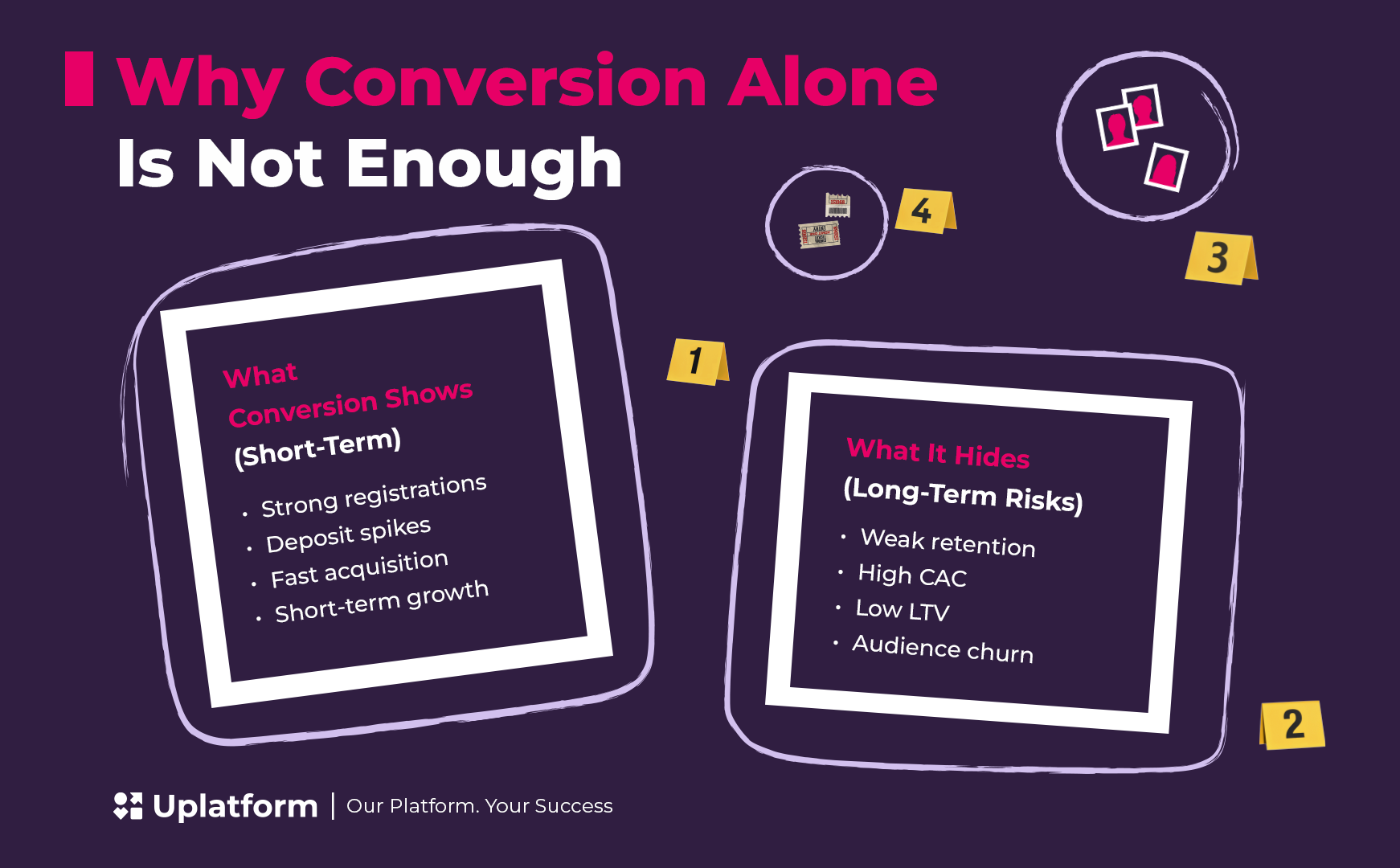
However, focusing too heavily on short-term metrics, like conversion, can hide less effective work in other areas. For example, user loyalty may drop, or continuous engagement may decline, but these problems stay behind the curtain and are not immediately visible. After some time, the operator may face unpleasant surprises, such as a sudden outflow of the audience, which is obviously not ideal,”
Dina added.
The hidden cost of short-term thinking
An overemphasis on short-term success metrics can mask gradual, less visible signals of long-term performance decline.
Metrics like overall engagement or player loyalty may appear stable until sudden drops occur, often signaling retention issues.
“It is difficult for me to give large, specific examples, perhaps because as a platform we work closely with our operators and can warn them about risks in advance. We often help highlight areas that need attention, so we can prevent such situations. Still, there have been cases where teams, excited by short-term conversion success, focused too heavily on one particular section or direction.”
Dina explained.“Meanwhile, they overlooked other areas that might have had less impressive numbers but were stable and showing steady, consistent growth. These parts do not shine as brightly, but their long-term value can be much greater. If you look a little deeper, the picture can turn out to be far less bright and much more grounded. For example, an operator might have a strong registration to deposit conversion. But at the same time, their cost of acquiring a single user could be inflated, and the returns from that user may not be enough. In practice, they end up doubling their spend per player. ”
This creates a familiar pattern in the industry: strong acquisition performance followed by unstable retention.
When strong conversion hides weak economics
A great conversion rate shows that you have acquired a lot of new players, but what many in iGaming overlook is whether or not you have a healthy conversion rate. It’s possible for conversions to increase and profitability to decrease, especially in cases where player acquisition costs escalate faster than the player’s lifetime value.
The result is dashboards that show positive momentum while the underlying economics keep getting worse, giving a false sense of success.
“So on paper the traffic looks “high quality” thanks to the conversion rate, but in reality the LTV may not cover the CAC. On the surface it looks like growth, high conversion, nice charts, a success story. In the long run though, the operator is essentially buying losses.
They are paying more than they earn. You can catch these issues through other metrics, especially behavioral ones. As a result, the operator may face the effect of lost potential revenue. Therefore, it becomes a strong reminder of the importance of predictive thinking: not everything that shines right now is actually what brings the greatest value.
Sometimes the real potential lies deeper, and you have to dig a little to find it. That is often what brings the most value in the long run.”
This disconnect is one of the most common hidden risks in performance-driven growth models.
What actually defines sustainable growth. Sustainable growth in iGaming is not driven by a single metric. Instead, it emerges from the balance between product quality, market fit, user experience, and timing.
Operators often underestimate how important timing is, especially when scaling or optimizing based on incomplete data.
“This might not be the most popular opinion, and I will not dive deep into the technical side like AI and personalization, though they matter. But I believe it is essential to look at everything holistically. An operator might have a strong expert team, a well-built product, proper localization for specific markets, deep understanding of its players, and the ability to retain them.
But even if all of that is in place, there is still one key factor: the ability to focus on what matters in a balanced way. Not jumping from side to side, but acting consciously and consistently. Another crucial factor is timing.
It is strange to try extracting maximum value from metrics when a product is not ready. If a feature exists but there is no analytical foundation, or if the data sample is too small for objective conclusions, it is premature to push for results. And finally, everything comes down to clearly defined goals. Depending on whether you are targeting short-term or long-term results, both the metrics and the way you evaluate success will differ completely.”
When teams optimize too early or without enough data, they risk building strategies on unstable foundations.
Why retention and ARPU matter more than conversion
If conversion measures how players enter the system, retention and ARPU measure whether the system actually works. They determine whether acquired players generate ongoing value or disappear after initial activity.
“No project or brand can survive relying only on incoming traffic, just as it cannot function without understanding the cost of each acquired player. Retention and ARPU are two key indicators that show how the product evolves, how stable it is, and they help guide future decisions. “It is important not just to track these numbers, but to connect them in a chain and build them into the strategy.
You must understand why a player stays, what keeps them engaged, and then build on that foundation. All product metrics are interconnected. You can map out their influence on lifetime value, and from there, on the overall stability of the business.
New user acquisition is important, of course, but without strong retention, it loses its meaning. True brand growth is not built on registrations, it is built on engagement, loyalty, and trust between the user and the product.”
Without this connection, conversion becomes a shallow indicator rather than a growth driver.
Where operators typically fail in retention?
Retention challenges are rarely caused by a single mistake. Instead, they usually result from misalignment across product design, segmentation, and player acquisition strategy.
Common issues include targeting the wrong audience, lack of personalization, and over-reliance on bonuses instead of experience-driven engagement.
Dina explained: “I would not generalize too much, because retention issues tend to be very individual. Sometimes the problem is incorrect segmentation, the chosen retention mechanics may not match the actual user cohort. Sometimes the issue is a lack of personal approach: even with a strong product, if the operator cannot work with users individually, they risk losing them.
In other cases, new operators try to overload their product with features and bonuses. The idea is good, but it is easy to lose sight of fundamental things like proper analysis of the user journey.
These basics get pushed aside in the pursuit of a “richer” product. Another common mistake is acquiring the wrong traffic. When a product attracts an audience that is not a good fit, retaining them becomes extremely difficult. This tends to affect newer operators more, while mature ones already understand what traffic works for which product.
And of course, tools matter. If the product lacks the technical ability to quickly make changes or test hypotheses, it slows everything down and reduces retention efficiency. In this industry, speed is key. Overall, every situation is unique.
A product is always a complex structure where every small gear matters. Missed opportunities usually stem from not seeing retention as a unified mechanism where product, communication, analytics, and the team are all interconnected.”
Retention, in this sense, is not a tactic. It is a system. Check out our latest ebook about Coversion vs. Long Term value and find out more.
Can churn be predicted before it happens?
Churn is rarely sudden. In most cases, it is the final stage of gradual behavioral decline.
Operators who monitor engagement patterns closely can identify early warning signs before players fully drop off.
These signals include reduced activity, lower deposit frequency, and changes in usage behavior over time.
“Today the event landscape changes daily. Any global or local event can affect audience behavior. Staying aware and able to interpret external influences is extremely important. It is also essential to maintain contact with users, not just by answering questions, but by analyzing their requests and understanding why they come at certain moments. You can often spot early churn signals there,” Dina explained.
“Then there is continuous analysis, including predictive analysis: behavior patterns, dips in activity, changes in deposit frequency, session duration shifts. You observe, analyze, and try to implement preventive measures. And you need proper tools, a strong CRM system that allows quick detection, fast reaction, and effective retention mechanics. Having the right tool is crucial, it makes all the difference.”
Predictive analytics and CRM systems play a central role in this shift from reactive to preventive retention.
Moving from reactive metrics to strategic thinking
The shift from short-term optimization to long-term strategy is not about abandoning conversion metrics. It is about reinterpreting them. Conversion becomes a diagnostic tool rather than a definition of success. Operators need to understand what each metric actually represents in the broader system of growth.
“Strategic thinking is not about dreams, it is about assessing your current state, resources, and capabilities realistically.
You must know where you stand relative to competitors and clearly see both your strengths and, crucially, your weaknesses,” Dina explained. “There are many frameworks that help form vision and build steps toward both short-term and long-term goals. The key is being ready to rethink and rebuild your strategy when the market demands it. And the market may require that suddenly.
Another important point: always understand why you are doing something and what value each decision is supposed to bring.”Sustainable growth comes from connecting immediate performance signals with long-term business outcomes.
Building Loyalty in iGaming: Dina’s Practical Advice for Operators
One of the most common challenges for iGaming operators is not acquisition — but retention. Turning first-time players into loyal, engaged players requires more than campaigns or bonuses. It demands a deeper understanding of product, audience, and timing.
We asked Dina, Head of B2B Projects at Uplatform, what operators should focus on when struggling to build a loyal customer base. Here’s her perspective:
“I would start with the basics. First, check whether the product matches the market and current trends. Sometimes the issue is not marketing, the product simply does not resonate with the audience. Localization of both the product and related services can be crucial.
We’ve prepared a detailed guide on this topic, which may be helpful: Real Localization, Real Insights. Second, evaluate the user experience honestly.
Understand what challenges the player faces, what irritates them, where negative triggers appear, where they may get lost. It is vital to listen to players, stay flexible, and respond quickly to feedback. Third, segmentation. Every cohort requires its own approach.
You cannot effectively work with the entire user base using a single template, someone will inevitably slip through. For this, a customer journey–focused approach works especially well — we covered it in our CJM guide. Fourth, a unique offer. Do not just know your player, understand what they want here and now, in this exact moment, what is interesting for them at this exact second. In today’s oversaturated market, players are more sophisticated than ever.
That is why finding points of connection and offering something personal and relevant is critical. There are real examples where improving onboarding or adjusting local communication had a dramatic effect on retention. This dialogue with the players matters, people want to feel understood, and gaming is no exception.”Dina explained.
Conclusion
Conversion will always remain an important metric in iGaming. It is fast, visible, and useful for measuring immediate response. But it is not a measure of success on its own. Real growth is defined after conversion in retention, engagement, and lifetime value. With Uplatform, operators can move beyond acquisition and systematically build long-term player value. Or as Dina summarized:
“We, at Uplatform, work holistically and build relationships with clients as partners. It is important for us to understand exactly what the operator wants, what goals they set, and then provide the right solutions, tools, and opportunities. We know our markets well, we understand their nuances, and we act not just as a service provider, but as a full expert partner who is ready to share experience and help when needed. We are genuinely invested in our operators’ success.
We constantly monitor industry trends, evolve ourselves, and give our clients access to the same opportunities so we can grow together. We localize extremely well. We can adapt our product to specific markets and to the operator’s needs, while maintaining high quality and speed, and constantly improving and optimizing.
And of course, we provide strong, modern solutions, high-quality software and a strong product that we continuously develop and enhance with new approaches, mechanics, tools, and features. Constant growth, constant development. Both ours and our clients’.”