
Behind the Scenes: How Strong Teams Determine Success in iGaming
Sustainable success in iGaming depends less on products or traffic and more on how the operator’s team and processes are built from the start.
Strong projects launch with clear ownership, stable payments, and aligned decision-making. As they scale, structured teams outperform chaotic ones by reacting faster to change, protecting player experience, and avoiding growth driven only by traffic. Long-term performance comes from coordination, analytics, and operational discipline, not from acquisition alone.
The iGaming industry continues to grow, driven by new markets, evolving regulations, and constant technological development. On the surface, success in this space often appears to be a matter of product quality, licensing, or marketing scale. Yet behind many stalled or failed projects lies a much less visible factor: how the operator’s team and internal processes were built from the very beginning.
In practice, projects rarely collapse on their own. Products do not fail in isolation. What usually breaks first is the operational structure supporting them.
Behind every sustainable iGaming project is a team capable of making decisions quickly, reacting to unexpected challenges, and scaling without losing control.
Launch Is Not a Testing Phase
For many operators, the launch stage is treated as a trial period. Features can be adjusted later. Processes can be improved after traction appears. Teams can be expanded once revenue starts flowing.
This assumption is often costly.
“At launch, there’s no time for a slow warm-up,” says Dina, Head of Projects at Uplatform . “Who stands at the helm determines how fast the project finds its course and whether it reaches its destination at all.”
Early-stage projects rarely have the luxury of learning through mistakes. User expectations are immediate. Payment friction is unforgiving. Competition is already established. This makes the initial team structure not just important, but decisive.
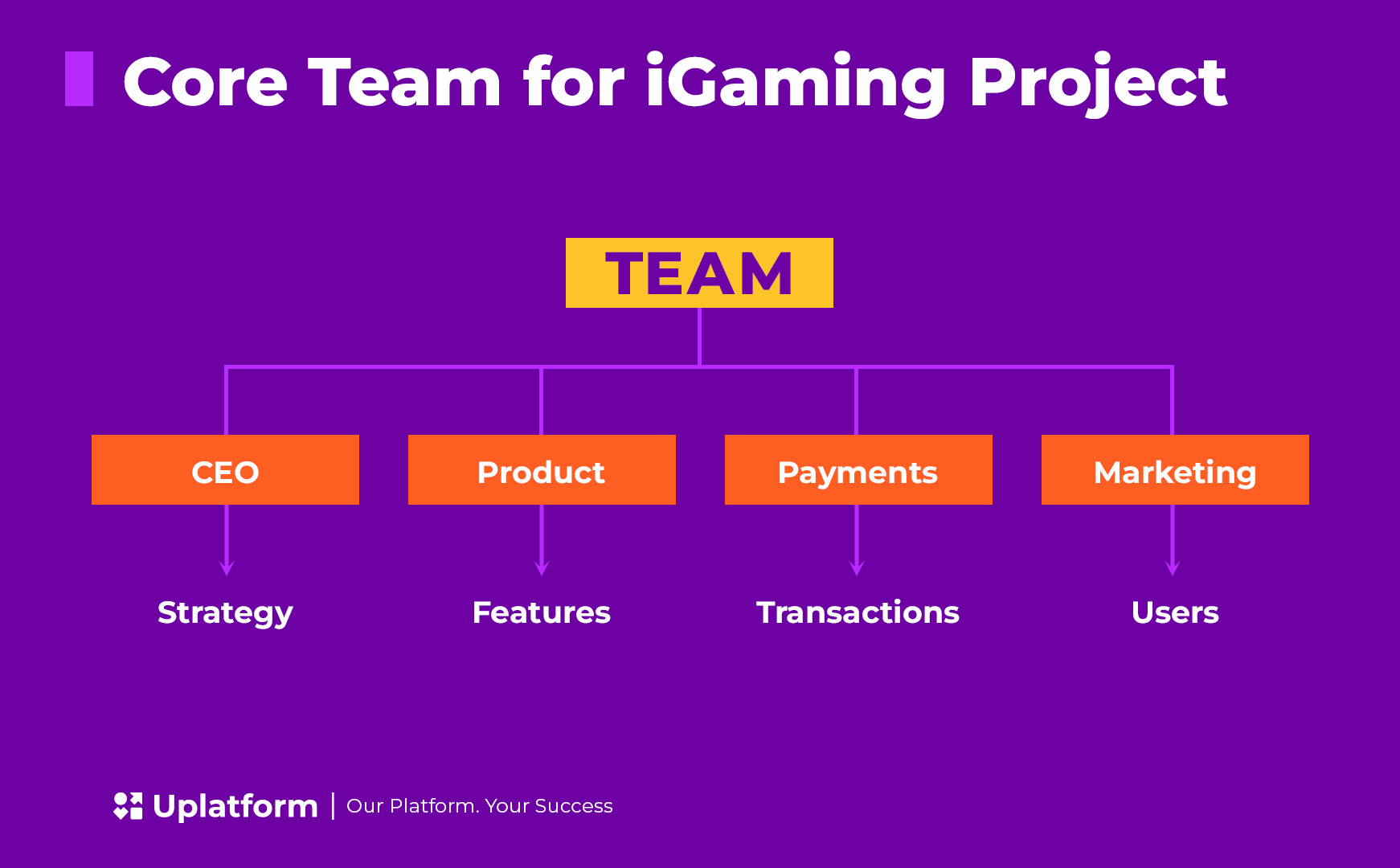
Successful launches tend to rely on a lean core team with clearly defined ownership rather than a broad but unfocused lineup. Strategic leadership is needed to set priorities and handle key negotiations. Product ownership ensures that the launch is driven by real player needs instead of assumptions or internal preferences. Payments expertise becomes critical immediately, as deposits and withdrawals form the backbone of user trust. Marketing completes the structure by attracting the right audience, not simply high volumes of traffic.
You should build the core team from the very beginning. Early-stage projects do not have time for long ramp-up periods. Results are needed immediately, which makes the initial team composition critical.
At a minimum, several key roles are essential:
CEO – sets the direction of the project and drives execution. At the start, this role is often directly involved in key negotiations and complex decisions.
Product Manager – a strategic role responsible for aligning the product with market and user needs. This person defines what should be launched, which features and promotions matter first, and how success is measured.
Payments Specialist – ensures stable and flexible payment flows. Deposit and withdrawal reliability directly affects conversion and survival in the market, making this role non-optional.
“Smooth payments are not a bonus feature. They’re a condition for survival,” Dina adds. “Conversion rates, flexibility for local markets, and the speed of reaction to new challenges directly affect whether players stay or leave.”
Traffic/Acquisition Specialist – responsible for bringing in the right audience and building visibility. Without users, even a strong product cannot grow.
This is a basic starting structure that allows a project to launch efficiently and avoid critical gaps.
However, there is no universal team model. The exact composition depends on business goals, budget, market specifics, and product type. The only constant is that the operator must clearly understand what they are building and why, and then assemble a team that fits that objective.
Growth Changes the Nature of Problems
As projects move beyond launch, operational pressure begins to shift. What worked at the early stage often stops working at scale. Payment methods that converted well initially may struggle under volume. Marketing channels lose efficiency. Compliance requirements evolve. Product complexity increases.
Importantly, these challenges rarely appear in a predictable order.
“Even experienced operators are often surprised by how fast the market can change,” Dina explains. “One day the challenge is payments, the next it’s marketing efficiency, and after that new requirements force changes in the product itself.”
Forecasting and planning remain important, but they do not eliminate uncertainty. The operators that scale successfully are not those who try to predict every issue in advance, but those who build teams capable of reacting quickly when forecasting stops working.
This is where process quality becomes more important than headcount. Simply adding people rarely solves structural problems. In many cases, it amplifies them.
Analytics is often the first pressure point. Teams that rely on intuition or competitor behavior tend to make reactive decisions, misallocate budgets, and chase short-term signals. Dedicated data ownership changes how fast teams can identify issues, test hypotheses, and adjust strategy.
As turnover grows further, financial control, technical ownership, and internal coordination become equally critical. Without documented processes and clearly defined responsibility zones, growth creates noise instead of momentum.
Structure Versus Chaos
Differences between well-organized and chaotic operators become visible very early.
“Well-organized operators work through documented processes, clear priorities, and measurable goals,” says Katerina, Team Lead, Key Account Management. “Chaotic teams operate in last-minute mode, constantly firefighting instead of building.”
This distinction becomes especially apparent during market expansion. Entering a new region is rarely just a marketing exercise. Payment methods must be adapted to local preferences. Legal and regulatory risks need to be assessed. Product localization requires technical coordination. Affiliate traffic needs proper onboarding and tracking. Customer support must be operationally prepared to handle real player traffic from the first day of launch.
Structured operators plan these activities in parallel, treating market entry as a coordinated operation rather than a single event. Less organized teams tend to launch first and resolve operational gaps later, often at the cost of retention, reputation, and internal efficiency.
In chaotic setups, growth frequently happens not because of the system, but despite it. Manual control replaces structure. Urgency replaces prioritization. Over time, this leads to burnout, inconsistent performance, and stalled scaling.
The Myth of Marketing-Only Growth
One of the most persistent misconceptions in iGaming is the belief that aggressive acquisition alone drives success. Marketing spend increases. Traffic flows in. Numbers look promising in the short term.
But without operational alignment, growth quickly plateaus.
“Many teams believe business grows purely through marketing,” says Katerina, Team Lead, Key Account Management. “Without analytics, stable payments, and coordination with the platform, scaling quickly starts to stall.”
In practice, acquisition performance is deeply dependent on what happens after the click. Payment conversion, onboarding flows, support response times, and retention mechanics all influence whether acquisition spend translates into sustainable revenue.
Teams that neglect these areas often experience high churn, blocked transactions, and escalating support issues. Over time, acquisition costs rise while lifetime value stagnates.
Player Experience as a Structural Decision
As operators mature, player experience becomes a defining factor. This is especially true for high-value segments.
In most iGaming projects, a relatively small share of players generates the majority of turnover, illustrating the Pareto principle in practice. Mature operators reflect this reality not only in strategy, but in team structure.
“In iGaming, 10–15% of players generate up to 80% of turnover,” Katerina explains. “That’s why successful operators always build dedicated VIP programs and separate fraud control. It protects margin and allows the business to grow predictably.”
VIP management is not simply about bonuses or personal communication. It requires trained staff, clear escalation processes, fast payouts, and coordination across departments. Predictive analytics helps identify valuable players early, while tailored retention strategies reduce churn before it becomes visible in headline metrics.
Fraud prevention follows a similar logic. Treating risk management as an afterthought often leads to uncontrolled losses, payment issues, and strained relationships with providers. Operators that integrate fraud specialists early build systems that scale safely rather than reactively.
Scaling Through Alignment, Not Pressure
As teams grow, internal alignment becomes just as important as external performance. Operators that succeed in scaling, do not treat their platform provider as a passive service layer. They work through coordination, shared priorities, and transparent communication.
One of the most common management mistakes observed by KAM teams is unilateral decision-making. Launching promotions without risk assessment. Changing payment flows without coordination. Applying pressure to support teams instead of addressing root causes.
These actions rarely accelerate growth. Instead, they introduce friction that must be resolved later, often under greater pressure.
Operators that invest in alignment tend to move faster over time. Clear points of contact, documented processes, and shared metrics reduce noise and improve decision quality across the board.
What Happens Behind the Scenes
Behind the scenes, sustainable iGaming success is rarely the result of a single decision or feature. It is built through dozens of structural choices made over time.
Strong teams launch faster, react better to change, and scale with control. Weak structures burn resources, lose players, and struggle to recover from operational shocks.
In an industry where markets evolve quickly and competition is relentless, team structure is not a background concern. It is one of the primary drivers of long-term performance.
Ultimately, the difference between struggling and thriving iGaming projects is not what happens on the surface, but how well the team behind it is built to handle complexity, uncertainty, and growth.
FAQ
What is the main factor behind long-term success in iGaming projects?
Strong team structure and clear internal processes. Products and marketing matter, but most failures come from weak operational foundations rather than from technology itself.
Why is the launch phase so critical?
Because the initial setup defines payment flows, product logic, and team ownership. Based on Uplatform’s launch experience, issues solved at this stage are far cheaper than fixing them after players and traffic are already live.
Which roles are essential at the start of an iGaming project?
A minimum viable team usually includes strategic leadership (CEO), a Product Manager, a Payment Systems Specialist, and a Traffic or Marketing Specialist. This covers direction, product-market fit, stable transactions, and user acquisition.
Why are payments considered a survival factor?
Because deposit and withdrawal reliability directly affects trust and conversion. If payment flows are unstable or poorly adapted to local markets, players leave regardless of marketing spend.
Is there a universal team model for all operators?
No. Team composition depends on business goals, budget, market specifics, and product type. The key requirement is clarity about what is being built and why.
Where do operators most often face operational problems?
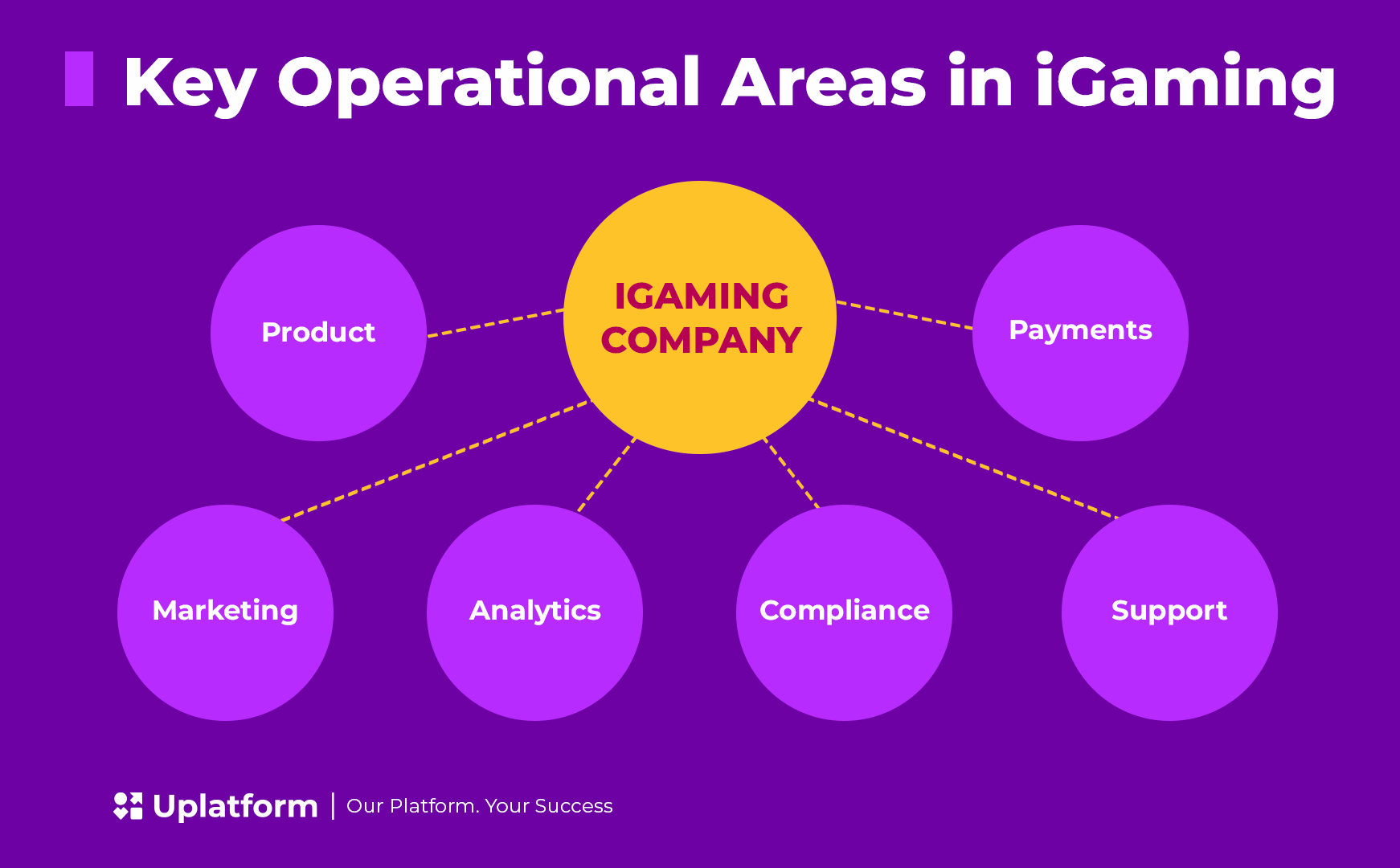
Issues can arise in product, marketing, payments, or compliance, depending on experience and market conditions. The decisive factor is not predicting every challenge, but reacting quickly when conditions change.
Why is acquisition alone not enough to scale an iGaming business?
Because growth depends on what happens after acquisition. Payment conversion, onboarding, support quality, and retention determine whether traffic becomes sustainable revenue.
How should operators work with their platform provider during growth?
Through alignment rather than unilateral decisions. In Uplatform projects, coordinated changes across payments, promotions, and risk reduce friction and improve execution speed.
What are the most common team management mistakes?
Relying on intuition instead of analytics, expecting full transparency from anti-fraud systems, and making operational changes without coordinating with the platform provider.
Is there a connection between team quality and business results?
Yes. Strong team management leads to faster launches, stable GGR growth, and higher retention. Weak management results in stalled scaling, wasted resources, and player loss.